Jaga controllers for hybrid and fan coil units

A comfortable indoor climate starts with the unit itself and how it is controlled. Proper control ensures that cooling and heating not only operate efficiently, but are also tailored to the room’s usage and the user’s expectations.
Control of Hybrid Convectors and Fan Coil Units
Hybrid convectors and fan coil units are controlled via a room thermostat or a building management system (BMS) that generates a heating or cooling demand. This control signal forms the basis for the unit’s operation and determines when cooling or heating is activated.
Depending on the configuration and type of unit, this demand is further processed by an internal control system or via external control. This allows the system to be tailored to both simple applications and more advanced building management systems.
Hybrid convector
A Hybrid convector is equipped as standard with a JDPC (Jaga Dynamic Product Controller). This controller features an integrated water temperature sensor on the heat exchanger and acts as a safety interlock for the fans.
The fans are activated only when the water temperature is suitable for the requested operating mode. This prevents cold air from being blown out during heating or warm air during cooling. If the water temperature is outside the permitted range, the fans remain off.
This logic ensures a stable and comfortable indoor climate, without unwanted air currents.
Fan Control for Hybrid Convector
After release by the JDPC, the fan speed is determined by the selected control strategy. This can be done in several ways:
- via a manually set fan speed on the product controller (ACO)
- via a manually set temperature control on the product controller (TPT)
- via an external 0-10 V control signal from a home automation system (BMS)
Depending on the application, control can be local or centralized, making the system flexible for use in various project types.
Fan coil unit

A fan coil unit can be optionally equipped with a JDPC (Jaga Dynamic Product Controller). Just like with the Hybrid Convector, this controller ensures intelligent fan activation based on the water temperature.
The fan only starts when the water temperature in the heat exchanger is suitable for the requested operating mode. This prevents cold air from being blown out in heating mode or warm air in cooling mode, which significantly increases comfort.
Fan Control for Fan Coil Units
The fan speed can be controlled in several ways:
- via a manually set fan speed on the product controller (ACO)
- via a manually set temperature control on the product controller (TPT)
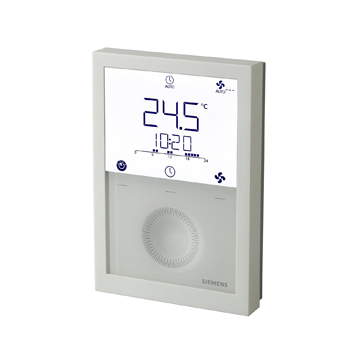
- via an external 0-10 V control signal from a building management system (BMS)
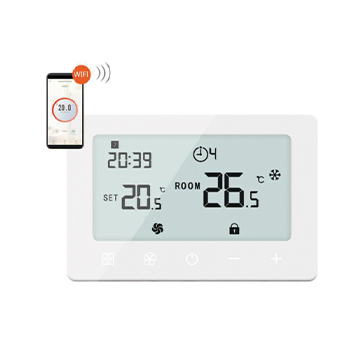
- via an external 0-10 V control signal controlled by a Jaga thermostat (SMART BMS – JRT)
Here too, control can be performed both locally and centrally, depending on the building’s needs and the desired level of control.
Fan Coil Unit without JDPC
When a fan coil unit is not equipped with a JDPC, the fan is controlled directly via an external 0-10 V control signal.
In this configuration, there is no water temperature sensor, and the fan is not activated based on the temperature of the water in the heat exchanger. This means that the fan can start up regardless of the water temperature.
As a result, there is no built-in protection against blowing cold air during heating or warm air during cooling. In this case, the correct and comfortable operation of the system is entirely dependent on the external control and proper coordination within the building management system.
Conclusion
The control system for hybrid convectors and fan coil units is modular in design and offers various options for meeting the specific requirements of a project.
By combining local control, central control via a BMS, and the optional use of intelligent components such as the JDPC, both simple and advanced control systems can be implemented.
A well-considered choice of control system largely determines the comfort level, energy efficiency, and reliability of the system. Proper coordination between the unit, the control system, and the application is therefore essential for an optimal indoor climate.