Never Too Hot Again? Building a Climate-Resilient Indoor Environment Together
The cooling scale as a guide to year-round comfort
Our homes are getting warmer. So the way we cool them needs to become smarter. For a long time, Belgian homes were primarily designed to keep out the winter cold and retain heat indoors. Insulation, airtightness and limiting energy losses were the main priorities. But with hotter summers, longer periods of heat and higher night-time temperatures, a new challenge is emerging: heat is becoming increasingly difficult to dissipate, causing homes and apartments to overheat more quickly.
A KU Leuven study illustrates the scale of this challenge. With an average temperature increase of two degrees, more than 500,000 Belgian houses and 150,000 apartments could experience at least ten heatwave days per year by 2039. With three degrees of global warming, almost the entire Belgian residential building stock could be exposed to prolonged overheating, while the cooling season could last at least two months per year.
Summer comfort is therefore no longer a luxury, but an essential condition for a healthy and comfortable living environment. The question is no longer whether we need to cool our buildings. The real question is how we can do so sustainably, energy-efficiently and with the future in mind.
Don’t cool immediately, but start with smart prevention
A comfortable indoor climate cannot be achieved simply by adding an installation or product. It requires a comprehensive view of the building, its surroundings and the people who live or work there.
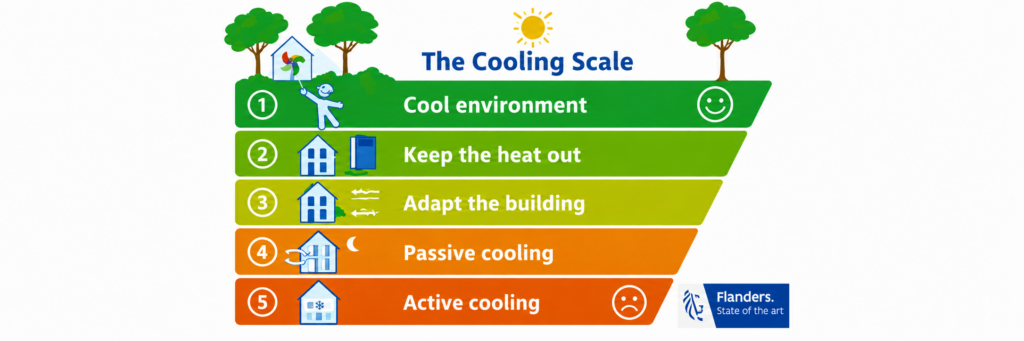
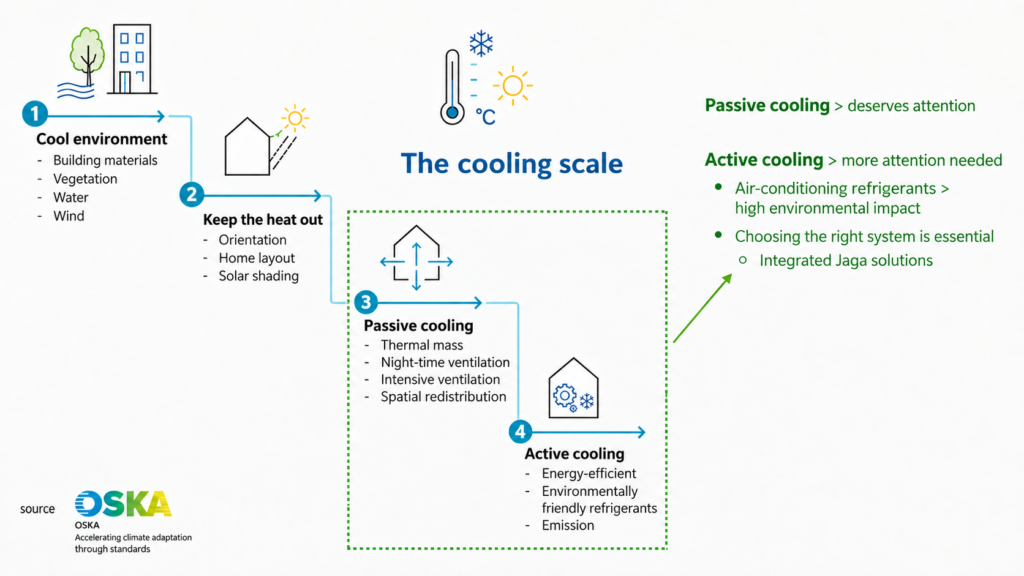
The Cooling Scale, developed by the Dutch Climate Adaptation Standards Consultation Platform (OSKA), provides a clear order of priorities. The principle is simple: heat that does not enter the building does not need to be removed through cooling afterwards.
Create a cool environment
Climate adaptation starts outside the building. Trees provide shade, plants and water help cool the surroundings, while reducing paved surfaces limits heat build-up in streets, gardens and buildings.
A heat-resilient home can therefore never be viewed separately from its garden, street or neighbourhood. By incorporating greenery, water and shade from the design stage onwards, we create not only cooler buildings, but also more pleasant and healthier living and working environments.
Keep the heat out
The next step is to prevent solar heat from entering the building. The building’s orientation, the size and position of the windows, solar-control glazing and effective external shading all play an important role in this regard.
Insulation also requires a balanced approach. In winter, it helps retain heat, but in summer, it can also prevent accumulated heat from escaping easily. A well-designed building therefore goes beyond energy performance in a single season and aims to provide comfort throughout the year.
Remove heat passively
If heat still enters the building, passive techniques can help remove it. These include intensive night-time ventilation, strategically positioned openings, cross-ventilation and the use of the building’s thermal mass.
Ventilation also plays a broader role. A healthy indoor climate is not only about temperature, but also about fresh air, humidity and air quality. Heating, cooling and ventilation should therefore not be designed as separate technologies, but should work together as components of a single integrated climate system.
Cool efficiently and precisely
During prolonged periods of heat and warm nights, passive measures will not be sufficient in every building. In highly insulated homes, apartments, healthcare facilities and buildings with large glazed surfaces, active cooling may be necessary to maintain occupants’ comfort and well-being.
In the Cooling Scale, active cooling is therefore a carefully considered final step towards a comfortable indoor climate. It is essential not to focus solely on treating the symptoms: the solution lies in a system-based approach.
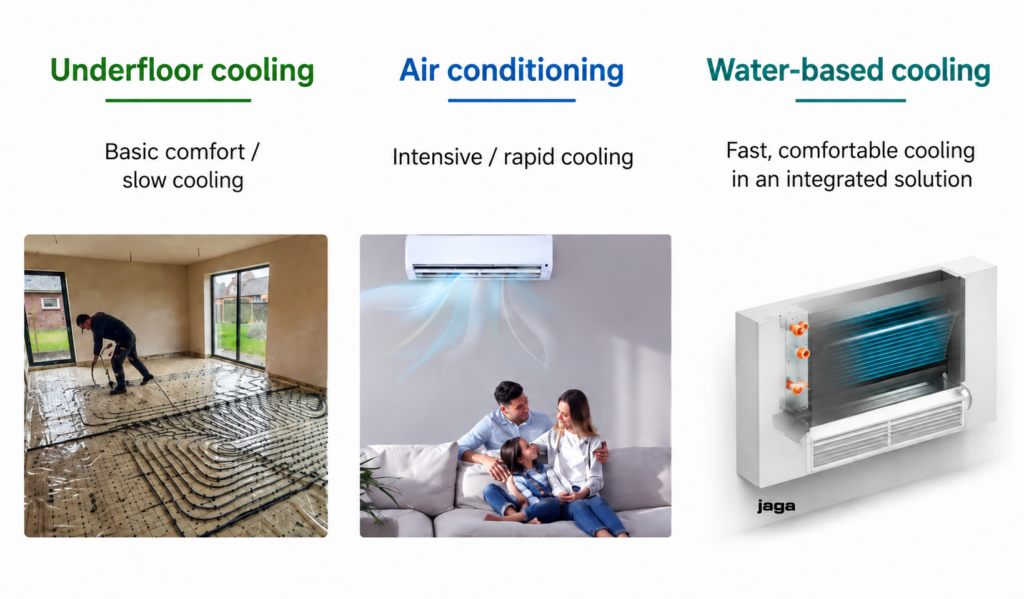
Looking beyond conventional air conditioning
These refrigerants are coming under increasing pressure. Europe is gradually phasing down the use of synthetic fluorinated gases with a high climate impact. Older refrigerants such as R410A have a global warming potential many times higher than that of CO₂. Rules are also becoming increasingly strict for more commonly used refrigerants such as R32.
The future therefore lies not in adding more separate appliances, but in a single integrated climate system for homes, office buildings and other non-residential buildings, in which heating, cooling, ventilation and domestic hot water work together seamlessly.
Water as a carrier for heating and cooling
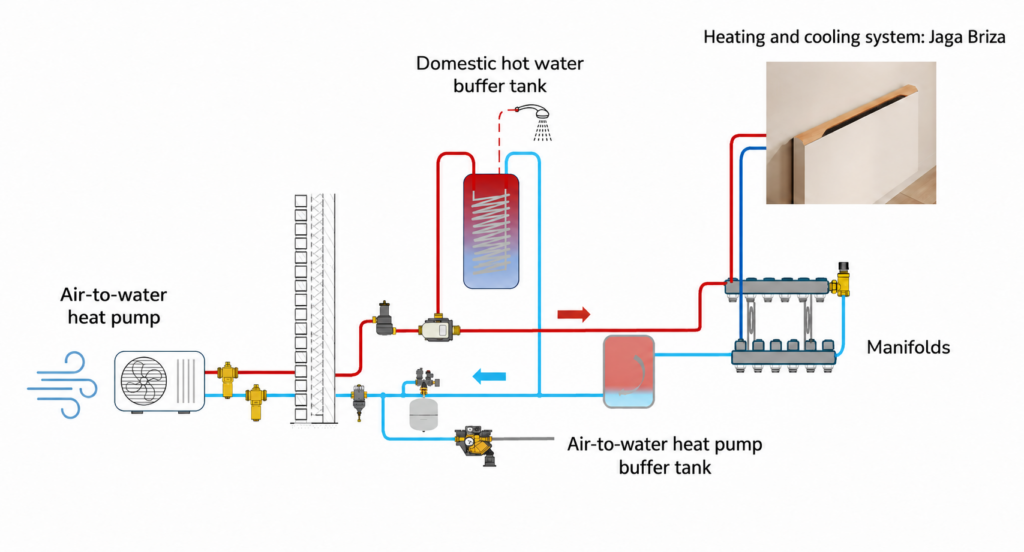
Water-based indoor climate solutions play an important role in such an integrated system. A heat pump can produce not only hot water for heating, but also chilled water for cooling. Choosing the right water-based distribution system then determines how efficiently and comfortably this energy is used in each room.
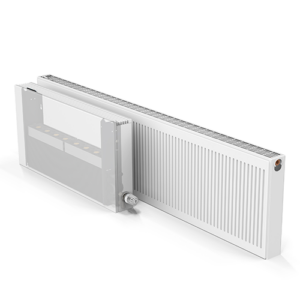
Heated or chilled water circulates through the same pipe network to, for example, hybrid convectors or fan coil units. In winter, they deliver warmth; in summer, they provide cooling. This allows the heat pump’s capabilities to be used throughout the year within a single integrated installation.
Combined with a modern monobloc heat pump using R290, a natural refrigerant with a very low climate impact, this setup offers a future-ready, integrated solution. The refrigerant remains contained within the heat pump, while water distributes heating and cooling throughout the building.
The benefits go beyond sustainability. Fan coil units respond quickly to changes in heating or cooling demand. Through active air circulation, they distribute heated or cooled air evenly throughout the room. Comfort is felt quickly, and the temperature can be controlled precisely in each room.
The heat pump therefore supplies heating and cooling, while the right water-based distribution systems ensure that both are delivered efficiently throughout the building. Together, energy generation and distribution form a complete solution for year-round comfort.
Non-condensing or condensing cooling
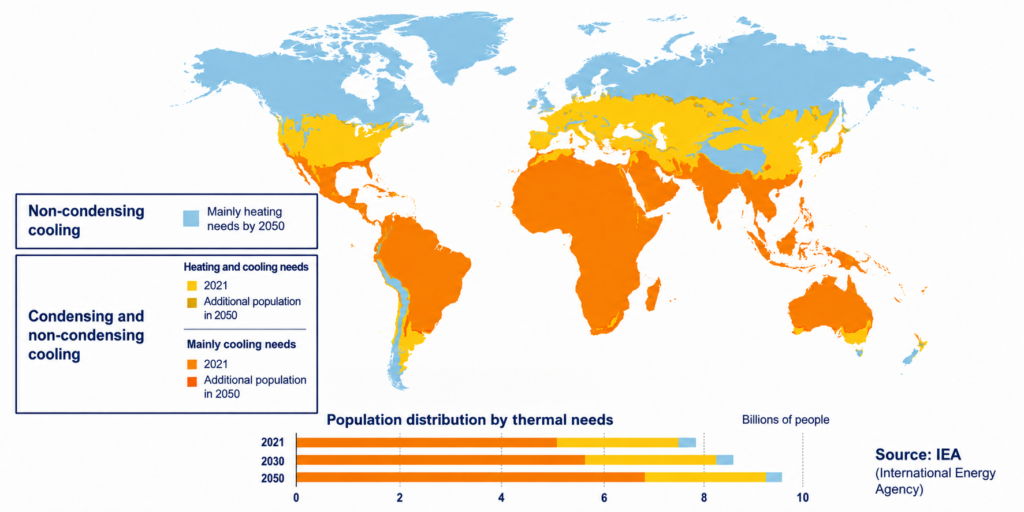
Depending on the building, the installation and the desired level of comfort, different forms of water-based cooling are possible.
Non-condensing cooling operates with water temperatures above the dew point. The system lowers the room temperature comfortably and energy-efficiently, without condensation forming. This type of cooling provides a pleasant level of basic comfort and is particularly suited to well-insulated buildings where preventive measures limit overheating and intensive dehumidification is not required.
Condensing cooling uses colder water. This allows the system not only to lower the temperature, but also to remove moisture from the air. It offers greater cooling capacity and is suited to south-facing buildings with extensive glazing and no or insufficient passive measures, such as external solar shading. The system must be designed to safely drain the condensate produced.
The right choice depends on how the room is used, its humidity load, the available installation and the expectations of its occupants or users. A good indoor climate system therefore starts not with a single product, but with a well-designed, integrated solution in which cooling, heating and ventilation work together seamlessly. The result is a system that is as energy-efficient as possible while providing the best possible comfort for living and working.
One system, tailored to people and buildings
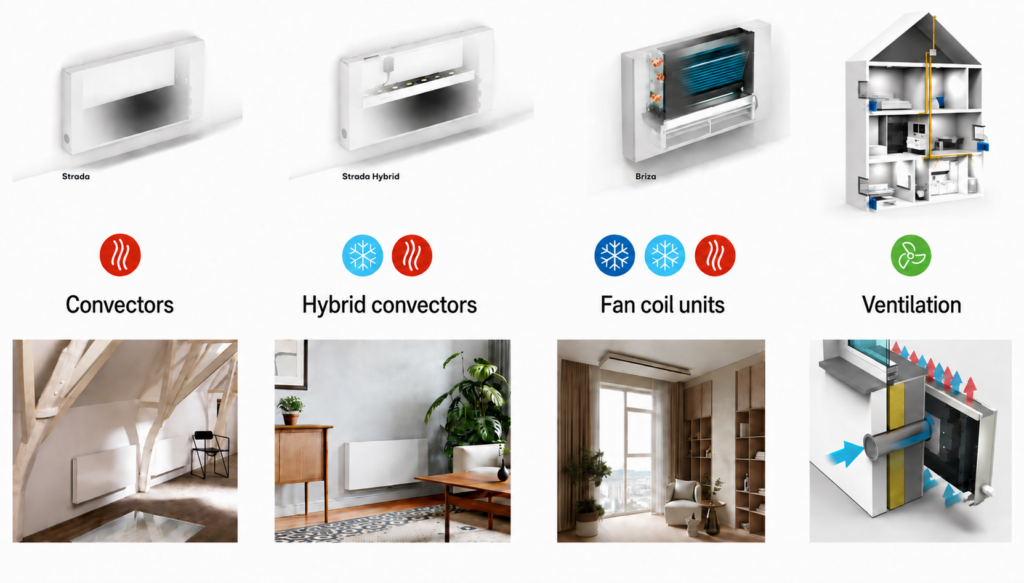
When renovating, hybrid convectors can often be connected to existing pipework. This makes it possible to switch to a heat pump with relatively limited modifications, while providing both heating and non-condensing cooling.
For major renovations or new builds, combining underfloor heating with fan coil units can offer additional flexibility. Underfloor heating provides gentle, energy-efficient background warmth, while fan coil units can heat or cool quickly and respond immediately to changing demand, such as sudden sunshine or a large number of visitors.
Rather than simply treating the symptoms, it is a smart combination that makes a real difference in the long term.
Designing for the summers of tomorrow
A climate-resilient building is much more than a well-insulated building. It is a living or working environment that can adapt to colder winters, hotter summers and changing needs.
By combining greenery, water, solar shading, construction choices, passive cooling, ventilation and water-based indoor climate solutions, we make comfort more sustainable. Not by maximising cooling everywhere, but by using energy efficiently and precisely where it is needed.
By treating the heat pump, distribution systems, ventilation and controls as one coherent whole, we create solutions that deliver comfort and energy efficiency, generation after generation.
Water-based cooling is therefore not simply a stand-alone alternative to air conditioning. It is an essential part of a broader, sustainable indoor climate strategy.
In this way, we bring technologies together and create homes and buildings that are ready not only for the winters, but also for the summers of tomorrow.